The first time I remember hearing the word divination was in Harry Potter. And, of course, Professor Trelawney gave us exactly the cliched picture you might expect: crystal balls, dramatic predictions, lots of scarves and even a slightly questionable relationship with reality. So, for a long time, if someone said divination, that was pretty much the image that came to mind for me.
Turns out, there’s a little more to it than that.
So, what exactly is divination?
At its simplest, divination is the practice of seeking information, insight or guidance through signs, symbols or other intuitive means. Traditionally, that has included seeking knowledge about things that are hidden or unknown—and yes, sometimes the future.
But I think this is where people can get hung up.
Divination doesn’t have to mean predicting that a tall, dark stranger is going to walk into your life next Thursday. I tend to think of it more as a way of having a conversation with your intuition, your higher self, Spirit, God, the universe—whatever language fits your beliefs.
And we’ve been having those conversations for a very long time.
Humans have used some form of divination across cultures and throughout history. People have looked to the stars, interpreted dreams and natural signs, cast objects and used all kinds of systems to seek guidance.
Today, some of the tools may look a little different, but the curiosity behind them is pretty familiar:
What am I not seeing?
What do I need to know?
Which direction feels right?
Basically, humans have apparently always wanted a second opinion.
Relatable.
Divination isn’t just tarot cards
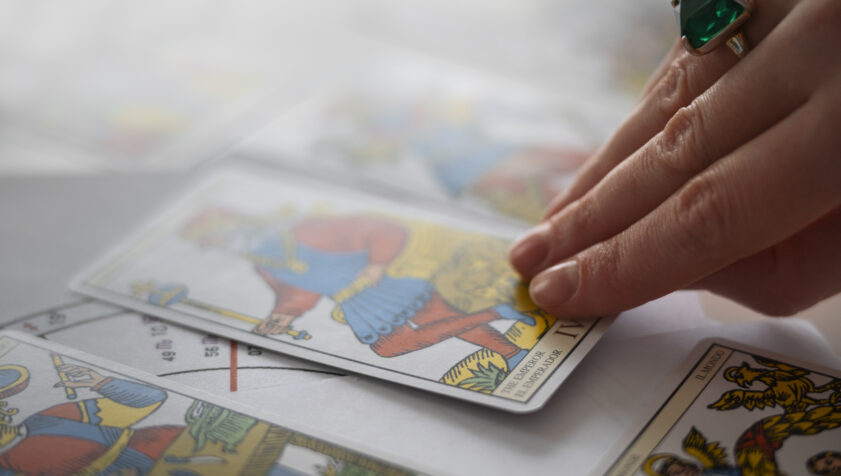
Tarot and oracle cards are probably some of the most recognizable divination tools today, but they aren’t the only ones.
Divination can include things like:
- Tarot and oracle cards
- Pendulums
- Runes
- Charms
- Casting bones or other objects
- Tea leaves
- Candle wax
- Scrying with water, mirrors, crystals or fire
- Astrology
- Numerology
- Dream interpretation
- And plenty of other practices
Some methods have established meanings and systems that you can study. Others rely much more heavily on what you see, feel, hear or sense in the moment. And that’s one of the things I find so interesting about divination.
The tool gives your intuition something to work with.
But is the tool actually doing anything?
Here’s where we get into the fun stuff. If I pull a tarot card, is that piece of cardstock magically giving me an answer? I don’t necessarily think so.
The card gives me an image. A symbol. A story. Something to react to.
Maybe I know the traditional meaning of the card. Maybe one tiny detail in the artwork immediately catches my attention. Maybe a thought pops into my head that seemingly has nothing to do with the card—but turns out to be exactly what I needed to consider.
The tool becomes a bridge between the question I’m asking and the information I’m receiving. You can explain that spiritually. You can call it intuition. You can believe it’s your subconscious noticing things your conscious mind hasn’t caught up with yet.
Personally, I don’t think we have to have all of that figured out before we’re allowed to explore it.
Curiosity is enough.
You may already be doing this
Have you ever asked for a sign? Opened a book to a random page because you felt like there might be a message there?
Had a dream that stayed with you all day? Noticed the same word, animal, number or symbol showing up over and over and wondered, Okay, what is going on here? Pulled a card and immediately thought, Well, shit. I know exactly what that’s about.
Welcome to the neighborhood.
Divination, at least the way I practice it, isn’t about giving away your power to a deck of cards, a pendulum or anything else. Actually, I think it can help us do the opposite.
It can help us practice listening to ourselves.
Start with curiosity, not prediction
If you’re new to divination, you don’t have to start by asking, What’s going to happen to me?
In fact, I think there are much more interesting questions.
Try:
What energy am I bringing into this situation?
What am I overlooking?
What could I pay more attention to right now?
What would help me move forward?
What do I already know but haven’t admitted to myself yet?
Then pull a card. Use a pendulum. Pick a charm. Watch a candle flame. Notice what comes up.
And write it down.
Don’t immediately worry about whether you’re “right.” Notice what you saw. What you felt. What caught your attention. What thought appeared out of nowhere.
That’s how you begin learning your own intuitive language.
The tool doesn’t get to run your life
I don’t believe divination should replace your judgment.
I wouldn’t let a tarot card make a major medical, financial or life decision for me. And if I have to pull seventeen cards until I finally get the answer I wanted in the first place… well, I probably already know what I want.
Divination is a tool.
It can offer another perspective. It can make us stop and look at something differently. It can uncover feelings or possibilities we haven’t consciously considered. But you still get to choose. Maybe that’s one of the things I love most about it.
For all the mystery we attach to divination, practicing it can actually teach us something incredibly practical:
How to listen.
To our intuition.
To our bodies.
To the things we notice.
To the questions that keep coming back.
Maybe the goal isn’t always to predict what’s coming next.
Maybe sometimes it’s simply to become a little more aware of what we already know.
Stay curious.